Microstructure and Composition
Several of the better preserved specimens, interpreted to be aptychi, were prepared for examination with the scanning electron microscope. It was hoped that using the SEM might cast new light on the problem of the affinities of these and similar fossils. The calcareous portions of cephalopod aptychi have a distinctive internal microstructure (Lehmann, 1981). This structure, if identifiable in the fossil specimens, would confirm the identification. Alternatively, the microstructure of authentic arthropod cuticle, and brachiopod and bivalve shells would be examined for comparison with the study specimens. Fish scales were eliminated from consideration as those in the Cleveland Museum of Natural History collection from the Late Devonian have distinctive morphologies differing from these aptychi (M. Williams, personal communication).
An International Scientific Instruments Model SX-40A SEM was used, with an attached Princeton Gamma Tech System 4 Plus energy dispersive x-ray spectrometer. It is routine practice in electron microscopy to coat the surface of the specimen with a conductive material to drain the accumulation of electric charge built up by electron bombardment.
1.  2.
2. 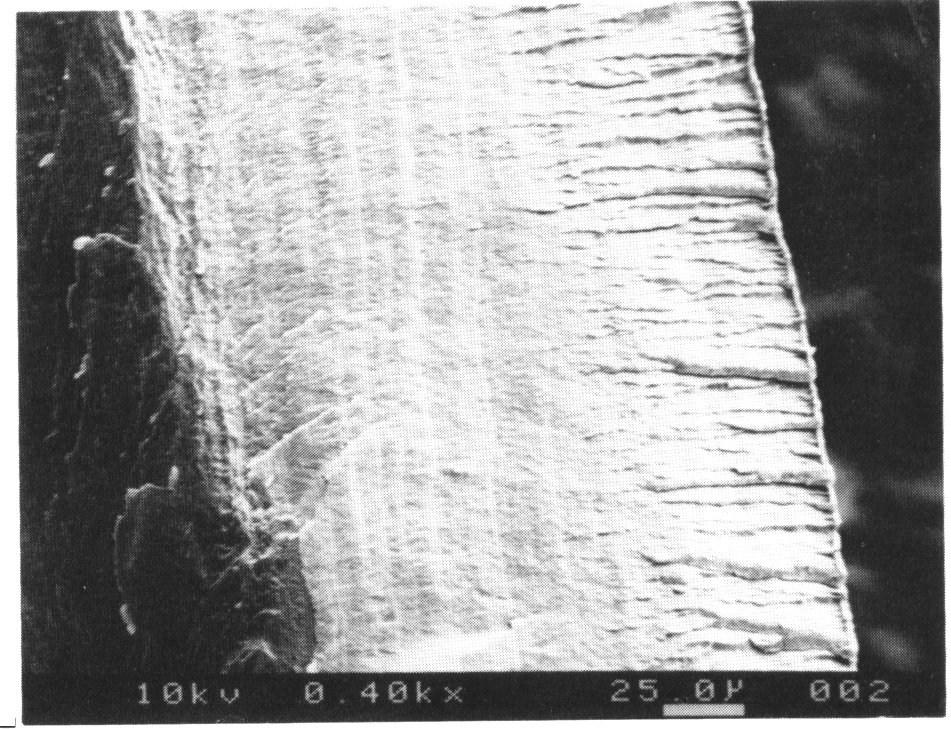
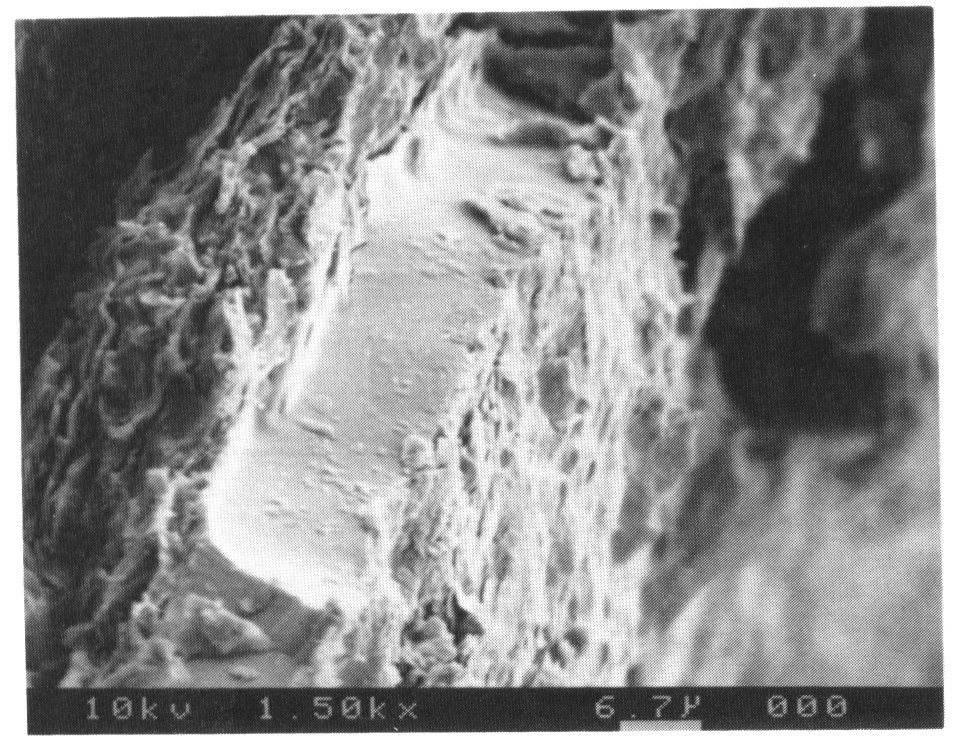
Figure 11 Scanning electron micrographs of the cross-sections of the unmineralized wing area of cephalopod jaws. No internal structure is discernable in either specimen. 1. Sidetes sp. CMNH 8317, a presumed Devonian anaptychus. 2. Nautilus pompilius, a modern nautiloid. Scales are in microns as indicated. The Devonian specimen has been considerably compressed. Click on the thumbnails for enlargements.
Examination of several aptychus specimens revealed no discernable structure remaining within the thin carbonaceous film (Fig. 11.1). All thicker regions examined were indistinguishable from the shale matrix and appeared to be molds. It seems that this method of investigation is of little value with material reduced to a carbonaceous film under anaerobic or dysaerobic preservational regimes.
Several of the first specimens examined were coated with gold to a thickness of approximately 500 angstroms, using ISI's P-S1 diode sputter coater. This procedure interfered with the use of the x-ray spectrometer, however. The K-alpha emission line for phosphorous has an energy of 2.014 KeV, while gold has an M-alpha emission line at 2.123 KeV, too close to the phosphorous line to be resolved (Goldstein, et al., 1981). A commonly used alternative is carbon coating, since the emission spectrum of carbon is entirely absorbed by the beryllium window in the detector apparatus. In the absence of a carbon coater, uncoated specimens were examined. This was successful, perhaps due to the high (4.60±1.09 wt.%) average organic carbon content of the Cleveland Shale (Broadhead, et al., 1982), and the carbonaceous nature of the specimens themselves.
The instrument was used to search for elements that might allow identification of the material composition of the aptychi. Qualitative energy-dispersive X-ray (EDX) spectra were obtained from aptychi and similar appearing fossils and parts from living organisms. The X-ray energy range from 0 to 20 thousand electron volts was scanned, allowing for the detection of nearly all the elements. Only those with atomic number less than berylium were undetectable, as the detector apparatus blocks X-rays from these elements. From the spectra obtained, the relative concentrations of calcium, strontium, and potassium within the samples were used to test for the calcitic, aragonitic, or phosphatic nature of the fossils. Other elements discovered were identified and indicated in the figures. The spectra were compared to test the usefulness of the method in solving this question.
1.  2.
2.  3.
3. 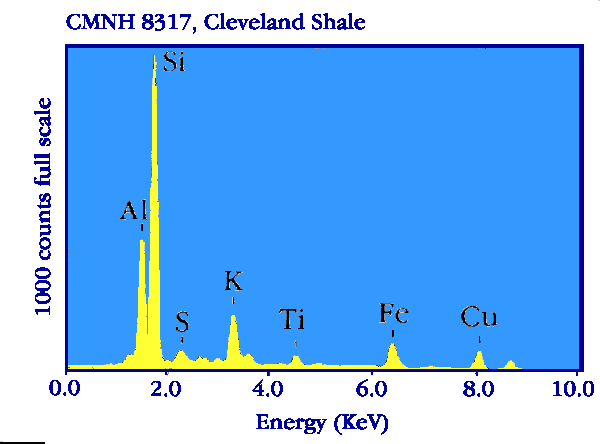
Figure 12. X-ray emission spectra revealing relative composition of some Cleveland Shale specimens. 1. a lingulid brachiopod. 2. Concavicaris, a crustacean, CMNH 3740. 3. CMNH 8317, a presumed Devonian anaptychus. Click on the thumbnails for enlargements.
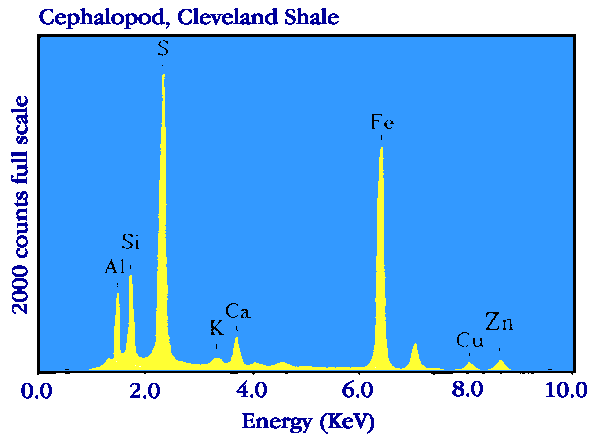
Inarticulate brachiopods and certain arthropods have long been considered the most likely alternative taxa to which aptychus-like structures might be assigned (Clarke, 1902). Therefore, specimens of a lingulid brachiopod (CMNH uncataloged) and the phyllocarid crustacean Concavicaris (CMNH 3740) from the Cleveland Shale were prepared for SEM and EDX examination. Analyses of these specimens and a representative anaptychus, CMNH 8317, are shown in Figure 12. While phosphorous is clearly present in both the phosphatic brachiopod and the phyllocarid, it is just as clearly absent from the anaptychus. Also conspicuously absent from the anaptychus is calcium or strontium, the latter being a common marker impurity used to identify aragonite (Crick, et al., 1987). It may be impossible to positively identify originally calcareous material from these units, however. Cephalopods tested from the Cleveland Shale, for example the one shown in Figure 13.1, were found to be significantly replaced with pyrite, which can be expected in the metal-rich, anaerobic conditions of deposition (Baird and Brett, 1986). Strontium in particular, present originally in trace amounts, may be undetectable in these altered specimens. The lack of pyrite replacement, common to many shelly fossils in the Cleveland, may suggest that the anaptychi were entirely chitinous in nature, with no mineralized portions.
Modern Nautilus mandibles contain phosphorous, but in small quantities as a trace element. While the exposed, oral portions of the mandibles are mineralized, the muscle insertion areas are often only lightly calcified if at all, consisting largely of a chitin/protein complex, only thinly coated with aragonite. This aragonite layer contains small deposits of brushite, a phosphatic mineral. Total phosphorous content of this posterior region is on the order of 0.30%. (Lowenstam, et al., 1984; Lowenstam and Weiner, 1989). This posterior region of the Nautilus mandible also reveals little internal microstructure beyond subtle layering, even with SEM examination (Fig. 11.2). What structure is seen seems to be an artifact of breakage. The thinness of the jaw specimen allowed for electron beam penetration through it and into the aluminum mounting stub when in the SEM. The X-ray analysis in Figure 13.2 reveals a strong aluminum peak for this reason. The other elements present in the analysis are common trace elements in sea water, and appear to have been incorporated into the structure in significant amounts. Perhaps diagenetic alteration resulted in the depletion of chlorine and enrichment in iron seen in the Cleveland Shale aptychi. The phosphate minerals were shown by Lowenstam, et al. (1984) to be limited to the carbonate layers, which are not present in the Devonian material.
1.  2.
2. 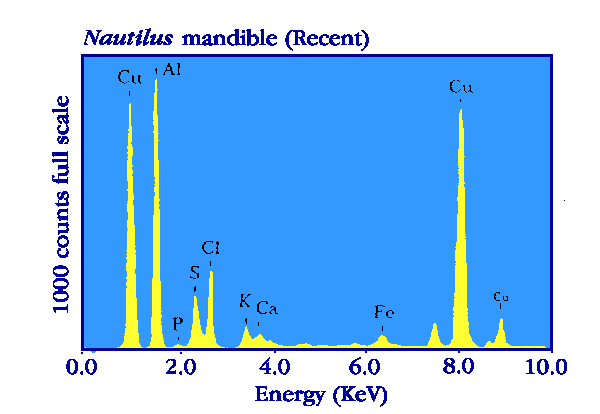
Figure 13. X-ray emission spectra revealing relative composition of 1. an unidentified cephalopod from the Cleveland Shale, CMNH 8705. 2. the wing or collar region of the jaw of modern Nautilus. Click on the thumbnails for enlargements.
The x-ray analysis, thus, presents evidence denying an arthropod or brachiopod affinity for these fossils. While there are other possible origins for carbonaceous fossil fragments, two of the most likely alternatives based upon the morphology of the fossils are eliminated from consideration. The most parsimonious interpretation is that these are indeed cephalopod aptychi, as suspected by Clarke (1902), Girty (1909), and particularly Ruedemann (1916).