Sidetes emersoni (Clarke, 1882)
1. 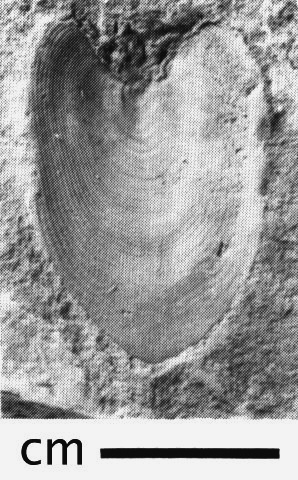 2.
2. 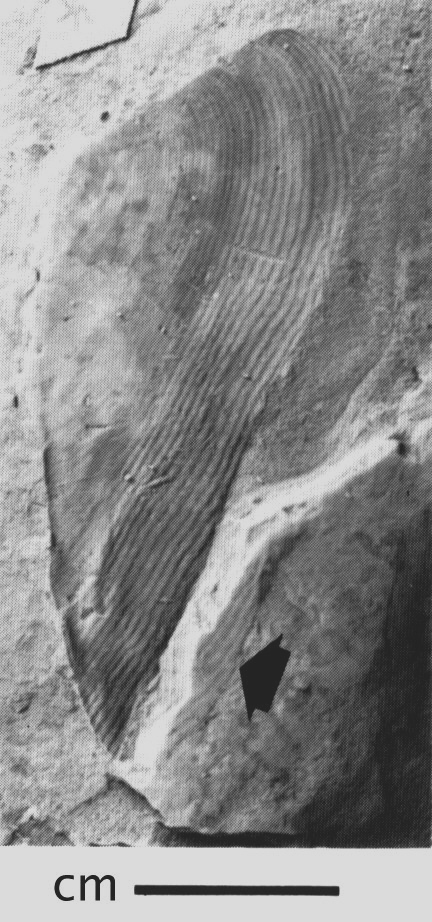
Figure 4 Sidetes emersoni (Clarke, 1882). Hypotypes from Millboro, Virginia. 1. USNM 97992-a 2. USNM 97992-b. Arrow points to fragment of opposite wing preserved on elevated portion of the matrix. Scale is one centimeter. Click on the thumbnails for enlargements.
Spathiocaris emersoni CLARKE, 1882
Diagnosis.--Structure semielliptical, length greater than width. Posterior margin rounded to subtriangular. Narrow, greatest width at anterior wing angle. Anterior margin deeply concave, notched. Concentric ridges closely arranged, well-marked.
Description.--Fossils are semielliptical to subtriangular, width 2/3 to 4/5 length. Greatest width measured between wing angles, anterior of rostrum. Length ranges from 18 to 40 mm, width from 12 to 32 mm. Posterolateral margins straight to broadly curved. Ornamentation fine, about 20/cm, concentric with posterolateral margin, bending toward median at anterior margin. Anterior angle deeply concave, angle near 120 . S. emersoni is narrower than S. newberryi or S. gouldi, while the deep anterior angle differentiates it from S. ulrichi, S. chagrinensis, and S. lata. In outline, it does not possess the sharp angle where posterior and lateral margins meet, as does S. lutheri, being instead nearly triangular.
Types.--Clarke's type specimens were from the Portage shales in Naples, Ontario Co., New York. They have apparently been lost. Two specimens collected by Butts (1942) and now in the National Museum of Natural History, USNM 97992-a and -b, are designated as "hypotypes."
Material.--The specimens studied were the hypotypes, from Millboro, 1.6 km south of Shawver Mill, Virginia.
Remarks.--It is interesting that none of the Ohio nor Oklahoma specimens can be assigned to this, the type species for the genus Spathiocaris. Only the one specimen of S. lutheri may possess an anterior margin as concave as S. emersoni. All other specimens studied have shallower or convex anterior margins.