Sidetes gouldi (Cooper, 1932)
1.  2.
2. 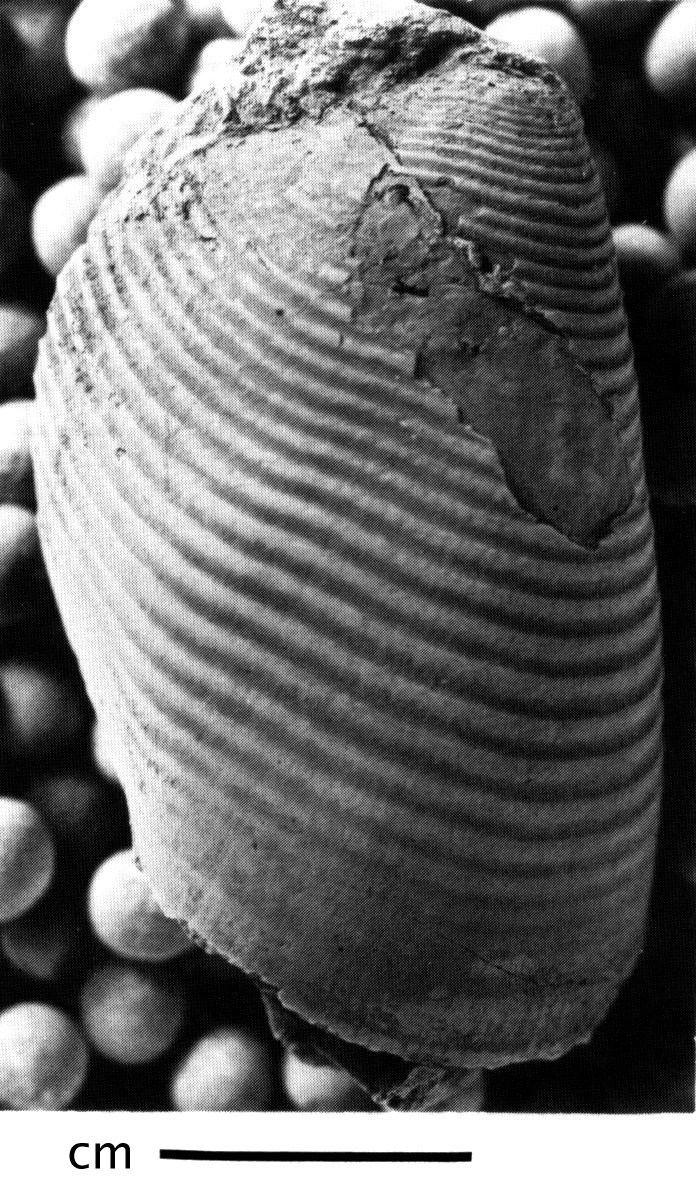
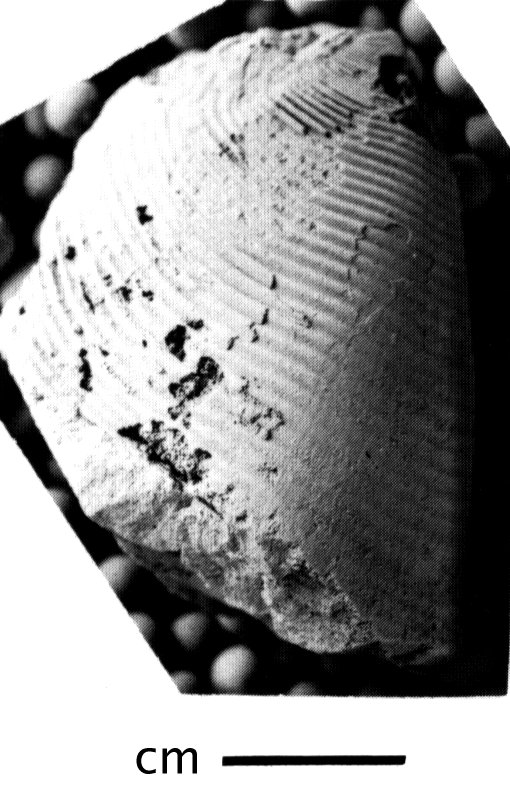
Figure 5 Sidetes gouldi (Cooper, 1932), from the Arbuckle Mountains. 1. USNM 112023, holotype, from Sycamore Creek, OK. 2. USNM 112034. Scale is one centimeter. Click on the thumbnails for enlargements.
Spathiocaris gouldi COOPER, 1932
Diagnosis.--Structure large, semielliptical, broad; width about 1.5 times length. Anterior angle straight or broadly concave. Ornamentation concentric with posterolateral margin, terminating anteriorly with inward bend toward median; spacing coarse, about 8/cm.
Description.--Fossils are large, length about 40 mm, outline semielliptical. Broad, width about 65 mm (1.5 times length). Anterior angle appears nearly straight. Ornamentation consists of ridges concentric with posterolateral margin, spaced about 8/cm. Anterior portions of ridges bend inward toward median. S. gouldi and S. newberryi are the broadest species studied, all others being much narrower. S. gouldi is slightly less broad than S. newberryi, which approaches a width/length ratio of 2 to 1. S. gouldi is further distinguished from S. newberryi in that the ornamentation is half as finely spaced as that of the latter.
Types.--Cooper's (1932) type material, now at the National Museum, includes the holotype, USNM 112023, and a syntype, USNM 112034. USNM 112035, another syntype, is smaller and is ornamented with much finer ridges than the other two specimens. It is also much narrower in outline than the others, and properly belongs with S. chagrinensis, instead. The two types for this species are from the Arbuckle Mountains in Oklahoma; the holotype was collected from Sycamore Creek.
Material.--Specimens studied were USNM 112023 and 112034. None of the Ohio specimens of appropriate breadth exhibit ornamentation so coarse as to permit their assignment to this species.
Remarks.--The two specimens have been removed from their surrounding concretions, and the anterior margins are poorly preserved, making determination of the anterior angle difficult. There is no indication, however, that it was significantly concave, but rather it appears to be nearly straight. While frequently the spacing of the ornamentation near the rostrum is finer than elsewhere on specimens of Sidetes, even this finer region is more coarsely spaced than the ridges of S. newberryi, allowing easy distinction of the two species.