Sidetes lutheri (Clarke, 1882)
1.  2.
2. 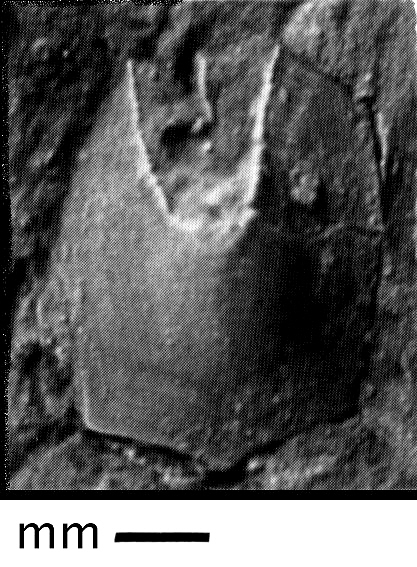
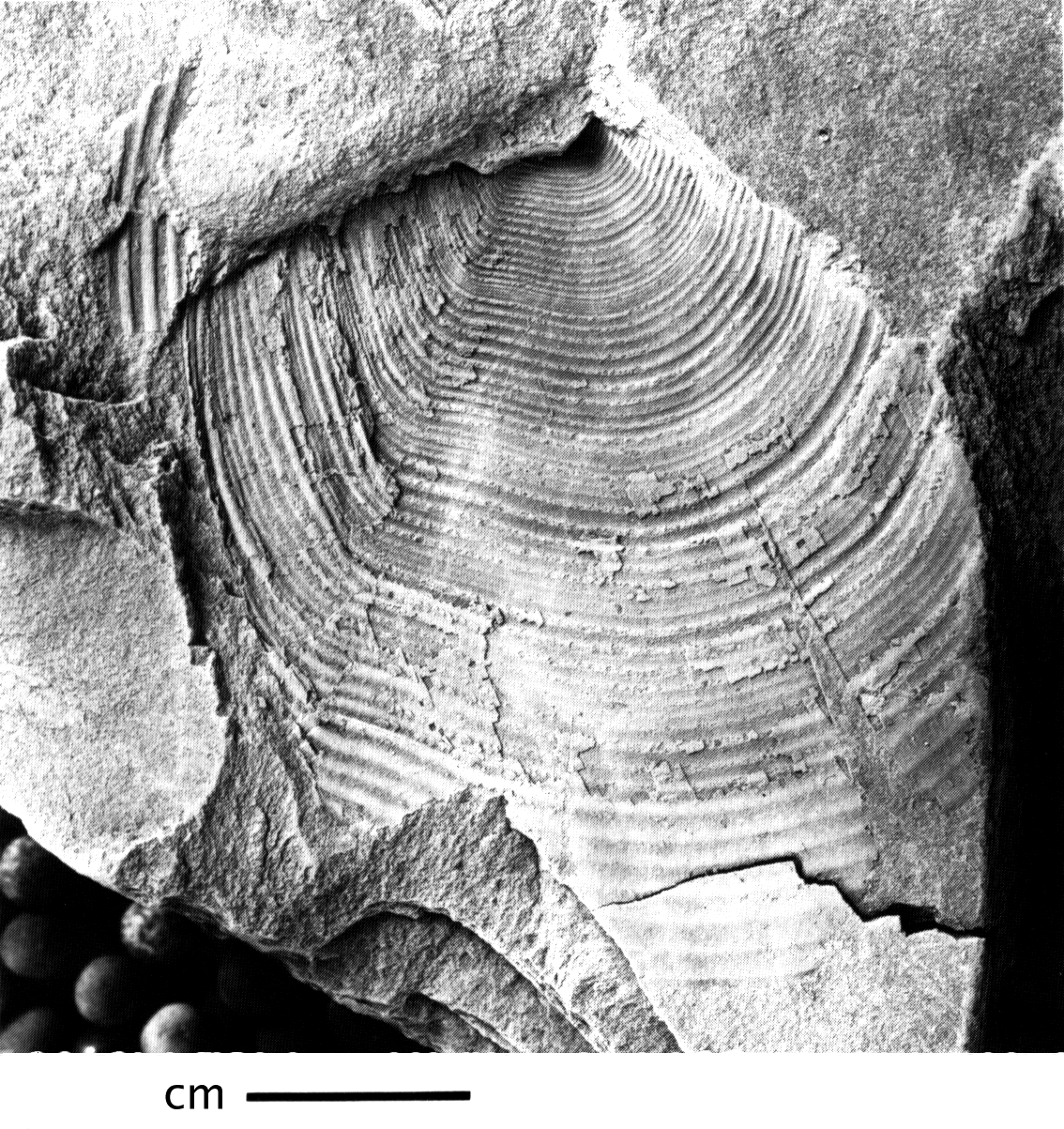
Figure 7 Sidetes lutheri (Clarke, 1882). 1. CMNH 8302. Scale is one centimeter. 2. USNM 264093, the holotype. Scale is one millimeter. Click on the thumbnails for enlargements.
Lisgocaris lutheri CLARKE, 1882, p. 478.
Pholadocaris lutheri (CLARKE, 1882)
Diagnosis.--Outline sub-pentagonal, lateral edges parallel, meeting posterior margins at sharp angles.
Description.--Fossil large, length greater than 47mm, width 43mm. Outline sub-pentagonal; lateral margins parallel and meeting posterior margins at a sharp angle. Surface ornamented with concentric ridges parallel to margins, spaced about 16/cm. Ridges turn inward toward rostrum near anterior margin, which is not preserved. The unique outline and approximately equal length and width serve to distinguish S. lutheri from all other taxa in this study.
Type.--The holotype is USNM 264093, in the collection of the U. S. National Museum. It was collected from near the base of the Hamilton Formation in Mile's Gully, Hopewell, New York.
Material.--In addition to the holotype, one Ohio specimen was examined. CMNH 8302 was collected in 1938 by P. A. Bungart from an unidentifiable locality near Linndale in the Berea quadrangle map. No stratigraphic information was recorded.
Remarks.--Clarke's (1882) description of Lisgocaris lutheri was based on a single, very small specimen measuring only two by three millimeters. The distinctive configuration of the margins and concentric ornamentation, however, is maintained in the much larger CMNH specimen. Clarke described the species in reverse orientation to that given above, with an "abdominal" cleft beginning centrally and widening to the "posterior" margin. This anterior region is not preserved in the CMNH specimen, so the size and shape of such a cleft cannot be determined. There is evidence that the lateral margins extended anterior of the rostrum a slight distance, but whether the anterior angle was obtuse or acute remains unknown.