Sidetes newberryi (Whitfield, 1882)
1.  2.
2.  3.
3.  4.
4. 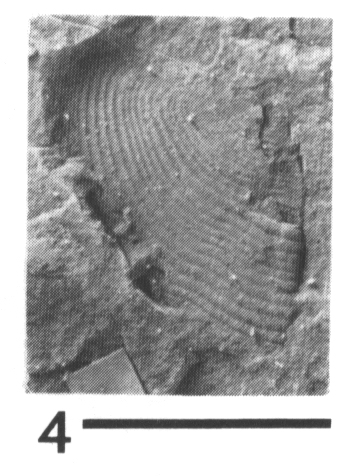
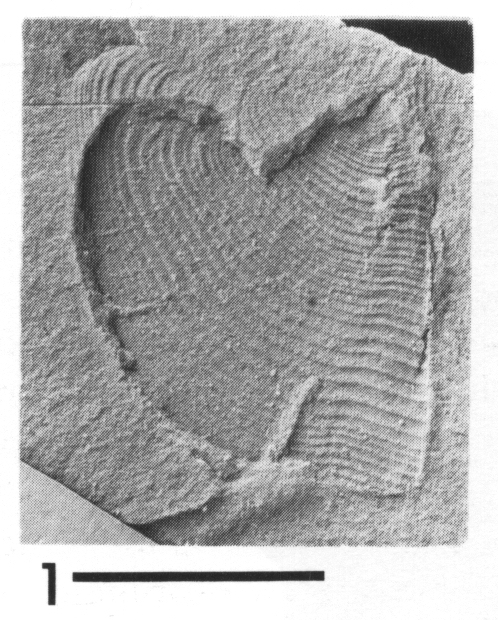
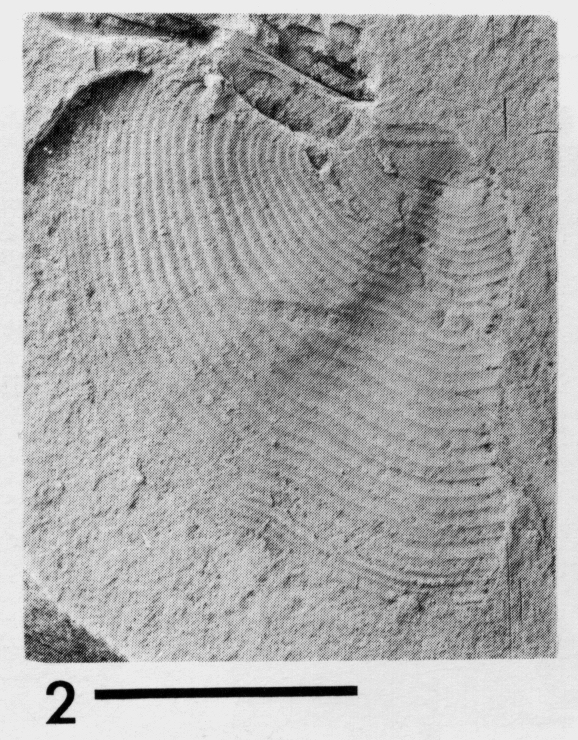
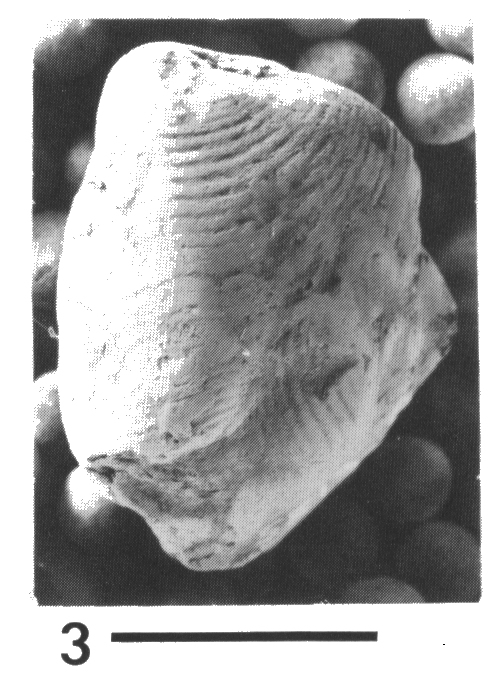
Figure 8 Sidetes newberryi (Whitfield, 1882). Type specimens, from Erie County, Ohio. The remaining specimen in the type series is too degraded to reveal detail, and is not illustrated here. 1. AMNH CU 7452G. 2. AMNH CU 6686G. 3. AMNH CU 5513G. 4. AMNH CU 6063G. Scale is one centimeter. Click on thumbnails for enlargements.
Plumulites newberryi WHITFIELD, 1882
Turrilepas newberryi (WHITFIELD, 1882)
Idiotheca rugosa GIRTY, 1909
Spathiocaris cushingi RUEDEMANN, 1916, p. 96
Spathiocaris woodfordi COOPER, 1932, p. 351
Spathiocaris plicifera COOPER, 1932, p. 350
Diagnosis.--Structure large, semielliptical, broad; width about twice length. Anterior angle straight or broadly concave. Ornamentation concentric with posterolateral margin, terminating anteriorly with inward bend toward the rostrum; spacing fine, about 16/cm.
Description.--Structure large, length from 10 to 43mm, semielliptical in outline, folded upon itself along the median line, forming a curved hinge. Broad, width 1.5 - 2 times the length. Anterior angle straight or very obtusely concave; anterior wings extend beyond hinge about one-fifth of total length. Entire structure extremely thin and flattened; in some specimens lateral margin is interrupted by one or more fissures, perpendicular to margin. Ornamentation of ridges concentric with posterolateral margin, spaced about 16/cm. Ridges continuous, terminating at anterior margin; anteriormost portion bent inward toward rostrum. S. newberryi is the widest species herein studied. Only S. gouldi approaches it in width, but has much coarser ornamentation. All other species are rather narrower.
Types.--Ruedemann (1916) described the new species Spathiocaris cushingi based upon two specimens of Turrilepas newberryi collected from the Cleveland Shale. These specimens were part of the Western Reserve University collection, parts of which are now at the Cleveland Museum of Natural History. These two specimens have not been located, however.
Whitfield's specimens of Plumulites (Turrilepas) newberryi are at the American Museum of Natural History (AMNH), and include the syntypes AMNH CU 7452G, AMNH CU 6685G, AMNH CU 6063G, AMNH CU 6686G, and AMNH CU 5513G. They were collected from the Cleveland Shale near Sheffield and Birmingham, in Erie County, Ohio. These agree in all details with Ruedemann's work and the specimens studied here, and do not exhibit the median carina nor multiple imbricate plates which might place them with the cirripedes. This species belongs with the aptychi.
Material.--Material studied includes Whitfield's five specimens of Turrilepas, and CMNH 8311 and CMNH 8318, from Big Creek, collected as float material, CMNH 8312, from Abram's Creek. CMNH 8320 and CMNH 8327a, also studied, have no reliable collection data recorded. Ruedemann's types were collected by Professor H. P. Cushing from the Cleveland Shale along Cahoon Creek, not far from Cahoon Cliffs. One specimen, CMNH 8668, has been found within the old Western Reserve University collection, but it does not appear to be one of Ruedemann's type specimens. Woodford Shale material assigned to this species are Cooper's (1932) types of S. woodfordi, USNM 112033 and 112040, and the holotype of S. plicifera, USNM 112030.
Remarks.--Ruedemann's description of Spathiocaris cushingi included mention of a second set of concentric lines centered upon the wing angles of the valve. This set "is but faintly shown" in the second, larger specimen he described, and may be invisible depending on preservation. Its absence should not rule out the assignment of the CMNH specimens to this species. Girty (1909) illustrated a new genus and species of Pteropoda, Idiotheca rugosa, from the "Woodford chert" [sic] at the base of the Caney Shale (Devonian-Mississippian) in Oklahoma. He was uncertain of its affinities, granting that it "may possibly be an aptychus...which occur so abundantly at a little higher horizon..." (Girty, 1909). Cooper (1932) redescribed the same specimen, USNM 112044, along with another, USNM 112033, as the new phyllocarid species Spathiocaris woodfordi. His Spathiocaris plicifera, holotype USNM 112030, differs from the rest only in preservation, bearing secondary corrugated folds. These Woodford Shale specimens are indistinguishable from Sidetes newberryi, and belong within this taxon.
Ruedemann (1916) also described another species from the Cleveland Shale along Mill Creek in Newburg, Ohio (Cleveland), Spathiocaris williamsi, which may represent another folded specimen with a hinge more strongly curved than S. newberryi. He described S. williamsi as being asymmetric and having the apex or rostrum displaced to one side of the "median line." This asymmetry is suspect. If we consider the lateral margin of his specimens nearest the rostrum to be the folded hinge line of a compressed specimen, the half which remains visible resembles S. newberryi strongly. Possible differentiating features might be coarser ornamentation (about 10/cm) and a superimposed concentric furrowing with a period of about 3-4mm. Insofar as Ruedemann's types have not been located for study, it seems prudent to consider the two taxa as separate.